
STANDARDISED ANALYSES
Turning microbiome signatures into actionable quantitative data
Challenges and complexities in the study of the gut microbiota
Challenges and complexities in the study of the gut microbiota
Unique to each individual, the gut microbiota is now at the heart of issues relating to health, nutrition and therapeutic developments. Research into it is essential to better understand its role, in particular in certain infectious or inflammatory diseases.
However, a large proportion of microbiota analyses still rely on data derived from sequencing and quantitative PCR, which are often difficult to compare or to utilise reliably over time. The ability to define a reliable microbiota signature requires tools capable of producing usable quantitative data, including from complex matrices such as faeces or wastewater.
The IAGE solution: supporting those involved in microbiome research
The IAGE solution: supporting those involved in microbiome research
At IAGE, we support researchers, healthcare professionals and biotechnology companies in the study and analysis of the gut microbiota, drawing on our recognised expertise in digital PCR (dPCR) and our standardised analytical methods, developed in particular through our experience working with complex matrices such as faeces, wastewater and other environmental samples. Our mastery of dPCR enables more reliable and sensitive absolute quantification, with fewer analytical biases than qPCR, particularly in these complex matrices with high concentrations of inhibitors.
Thanks to this innovative approach, it is now possible to precisely and specifically quantify target microorganisms, monitor microbiological dynamics in response to factors such as stress or treatments, and transform microbiota signatures into genuine decision-making tools.
Our teams are involved from the definition of targeted microbiota signatures through to the establishment of robust quantitative panels tailored to the needs of R&D, preclinical, clinical or industrial projects.
With over 1,200 probes developed, a standardised platform and methods adapted to inhibitor-rich environments, IAGE is able to define microbial signatures relevant to microbiological monitoring, biomarker research or the development of predictive models.
Our long-standing expertise in wastewater analysis, backed by COFRAC accreditation for the detection of viral pathogens, is a key asset in developing innovative approaches to the monitoring and analysis of environmental microbiota.
The benefits of the IAGE solution for microbiome research
The benefits of the IAGE solution for microbiome research
- Absolute and specific quantification of viable microorganisms.
- Access to modelling: Detailed analyses, identification of dynamics, and predictive modelling become possible using the quantified data.
- Reduced cost (multiplexing, industrial organisation): access to accurate quantitative data at a low cost and within very short timeframes. This opens up the possibility of scaling up measurements cost-effectively to carry out long-term monitoring and/or obtain statistically significant volumes of data.

ABSOLUTE QUANTIFICATION

DATA PROCESSING

COST REDUCTION
IAGE: innovative solutions for companies and laboratories working on the gut microbiota:
IAGE supports you at every stage of development, offering complete flexibility.
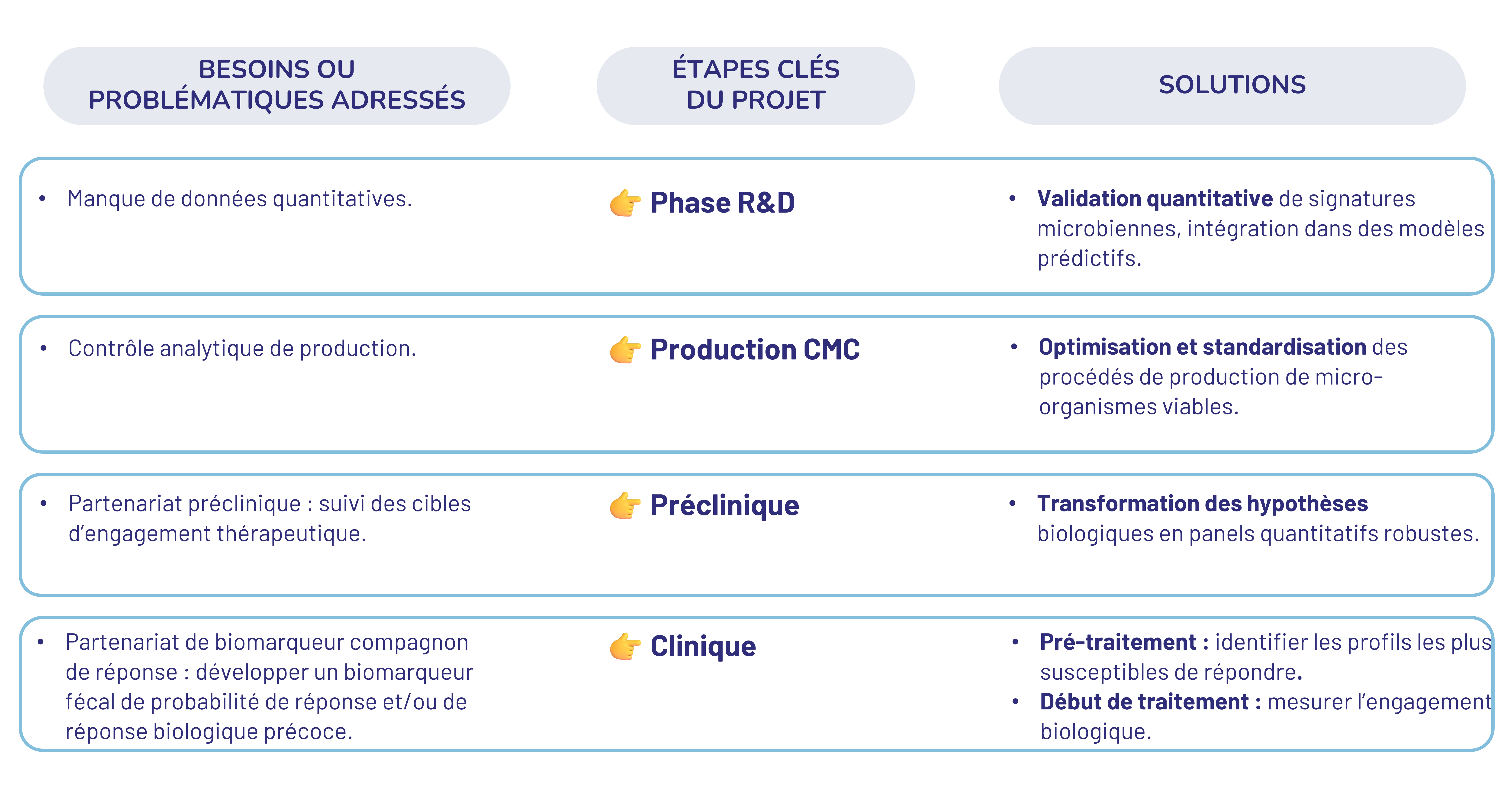
1) Absolute quantification on demand
1) Absolute quantification on demand
Drawing on its catalogue of targets, and developing new ones where necessary, IAGE carries out the required measurements, typically within 72 hours.
We operate as a contracted research organisation. To this end, IAGE holds CIR accreditation.
IAGE works with you to organise all the necessary logistics and traceability, regardless of the volumes required.
2) Support for research and/or product development programmes
2) Support for research and/or product development programmes
IAGE draws on its expertise and resources to support research programmes, for example into the evolution of the microbiota, or the development of treatments or probiotics.
We help to define the appropriate measures at each stage and carry out these measurements to the highest quality standards. We also provide our expertise in data processing, data visualisation and sharing tools, and modelling to support our clients’ research and development teams right through to the clinical phase.
3) Development of management or diagnostic tools
3) Development of management or diagnostic tools
Quantitative measurements and models can be used to develop effective decision-support tools: analytical production control or biomarkers, for example, by combining quantitative measurements with additional metadata.
IAGE can develop the necessary measurements and mathematical analyses to enable you to create tools that can be used in real-world conditions.
Finally, we can also develop tools for visualising results, sharing data and conducting analyses to meet your specific challenges and requirements.
PARTNERSHIP
IAGE Laboratory, a new partner of LE FRENCH GUT
IAGE Laboratory, a new partner of LE FRENCH GUT

Determined to get involved in the latest research emerging in this field, we have joined LE FRENCH GUT as a partner, both to carry out the necessary measurements and to contribute to the mathematical models that will be derived from the projects developed within this framework.
We are proud to contribute to advancing knowledge and to put our expertise at the service of this initiative.
